
Wedding DJ Requests: What Works, What Doesn’t, and What Uncle Dave Needs to Stop Doing
Wedding guest requests can be brilliant.
They can also be… an experience.
As a Wedding DJ and Host, I am very much in favour of requests. A good request can lift the room, bring people together, and turn a good dance floor into a “where did my shoes go?” kind of dance floor.
But not every request is a good idea.
Some requests are perfect for the moment. Some are better saved for the car journey home. And some arrive at the DJ booth with the sort of confidence usually reserved for people launching rockets.
So, should you allow requests at your wedding?
Yes.
But with a little bit of common sense, a little bit of guidance, and a DJ who knows when to say “greatshout” and when to say “I will see what I can do” while quietly moving the song to a very special foldermarked absolutely not.
Requests are not the problem. Bad timing, terrible songs and Uncle Dave with YouTube are the problem.
Why guest requests can be a good thing
Your guests are part of the party. They know songs from university days, family holidays, messy nights out, work parties, road trips, hen dos, stag dos, and all the tiny shared memories that do not always make it onto a carefully planned playlist.
A well-timed request can be magic.
It might be the song that gets your uni friends screaming. The one your family always dances to. The track that brings the evening guests straight onto the floor. Or the unexpected banger that suddenly makes three generations lose their minds.
That is the good stuff.
A request gives me useful information too. It tells me what pockets of the room are into, what guests are responding to, and where the energy might go next.
Used properly, requests are not a problem.
They are clues.
The best kind of wedding requests
The best requests usually have one or more of these qualities:
They fit the couple.
They fit the moment.
They fit the people currently dancing.
They have enough energy for the dance floor.
They are familiar enough for guests to actually respond.
They add to the party rather than dragging it sideways into a hedge.
A good request sounds like:
“Could you play something by ABBA? The bride’s family will go mad for it.”
That is useful.
Or:
“Any chance of some 00s indie later? There is a group of us who would love it.”
Also useful.
Or:
“The groom loves drum and bass. Is there a way to sneak one in?”
Absolutely useful – and possibly dangerous in the best way.
The trick is timing. A good request at the wrong moment can still fall flat. That does not mean it is a bad song. It just means the dance floor was not ready for it yet.
Wedding DJing is not just playing songs. It is knowing when a song belongs.
The requests that do not work so well
Then there are the other requests.
The seven-minute album track.
The obscure remix only three people know.
The song with a beautiful personal meaning but no dance floor pulse whatsoever.
The “everyone will dance to this” request from someone standing very much not dancing.
The track that empties a dance floor faster than someone saying “quick group photo outside.”
Not every song belongs in the middle of a wedding party.
Some songs are great songs. Some are meaningful songs. Some are excellent songs for listening to at home, in the car, or while staring moodily out of a train window.
That does not automatically make them wedding dance floor songs.
And that is where experience matters.
A good wedding DJ does not just ask, “Do I have this song?”
They ask:
“Will this help the party right now?”
If the answer is no, I will usually look for a better way to include the flavour of the request without sacrificing the whole dance floor to one person’s very specific musical journey.
The danger of “play this next”
This is where things get interesting.
Requests are welcome. Demands are different.
There is a big difference between:
“Could you play this at some point?”
and
“Play this next.”
Your wedding party is not a jukebox. It is not a pub quiz bonus round. And it is definitely not being run by whichever guest has had the most prosecco and the strongest opinions.
If a request fits, I will play it.
If it does not fit yet, I may hold it back.
If it is completely wrong for the moment, I may not play it at all.
That is not me being awkward. That is me protecting the party you asked me to create.
Good request
Could you play some 00s indie later? A group of us would love it.
Risky request
Play this seven-minute live version next. Everyone knows it.
They do not, in fact, all know it.
What Uncle Dave needs to stop doing
Every wedding has one.
It might not be called Uncle Dave. It might be a mate from work, a cousin, a bridesmaid’s boyfriend, or someone’s dad with strong views and a loosely tucked shirt.
But for the purposes of this article, he is Uncle Dave.
Uncle Dave means well. Usually.
He approaches the DJ booth with confidence. He knows music. He knows what “everyone” wants. He has a song in mind. He may have already requested it once. Possibly twice. Potentially during the first dance.
Uncle Dave needs to stop doing three things.
First, he needs to stop saying “everyone will dance to this” when everyone is currently dancing to something else.
Second, he needs to stop requesting the same song every ten minutes like he is trying to wear me down through repetition.
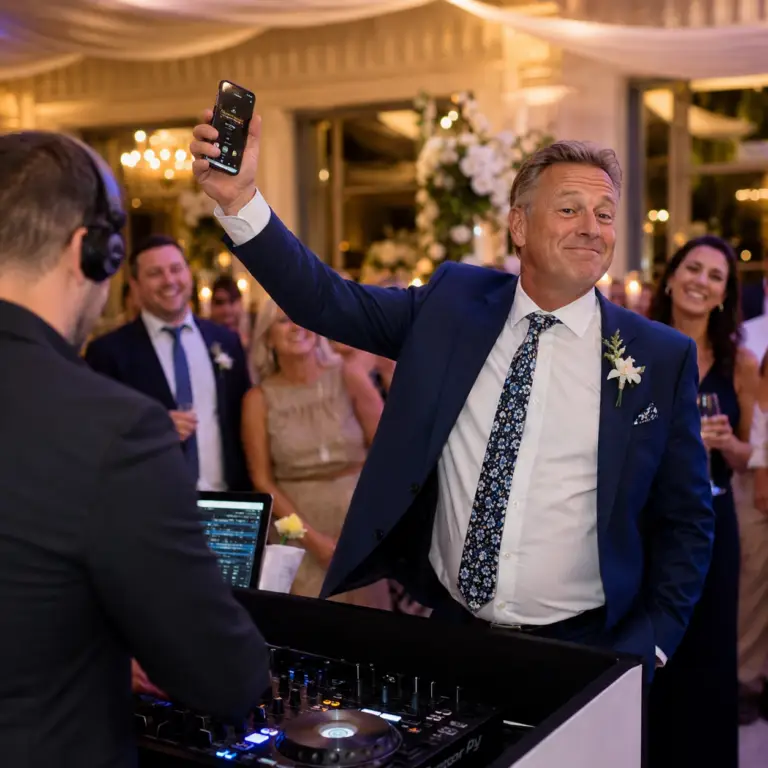
Third, he needs to stop showing me his phone while saying “it is on YouTube” as though that has solved every technical, musical and legal consideration in one heroic move.
Bless him.
We love Uncle Dave.
But Uncle Dave is not in charge.
Should you have a do-not-play list?
Yes. Absolutely.
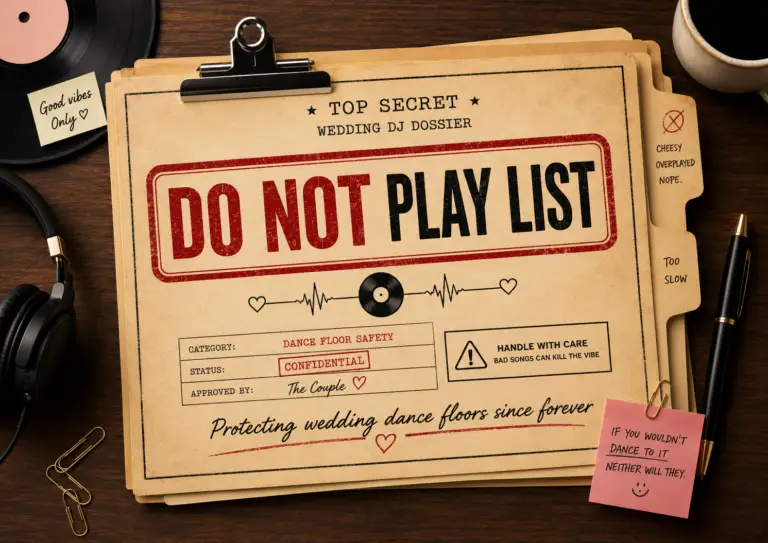
Your do-not-play list is one of the most useful things you can give your wedding DJ.
It does not need to be huge. It does not need to be dramatic. It just needs to tell me what you genuinely do not want to hear.
If you hate cheesy action dances, say so.
If there is a song you have heard at every wedding and never want near yours, tell me.
If there is an artist that reminds you of an ex, a bad night out, or a traumatic school disco, consider them gone.
A do-not-play list means I can handle requests confidently.
If a guest asks for something on that list, I will not play it.
No fuss. No awkward conversation. No need to announce that the couple have banned it by royal decree.
I will just steer things elsewhere.
Quietly. Politely. Like a musical ninja in sensible shoes.
Should you give your DJ a full playlist?
You can, but you do not have to.
A full playlist can be helpful if you love music and want to show me your taste. But it works best as a guide, not a script.
Your wedding party is a living, breathing thing. The room changes. Guests arrive. People drift to the bar.
Older relatives head off. Your evening guests appear with fresh energy. Someone’s nan suddenly turns out to be a garage enthusiast.
A fixed playlist cannot react to that.
A good DJ can.
The best approach is usually:
Give me your must-plays.
Give me your do-not-plays.
Give me a sense of the genres, artists and eras you love. Then let me read the room on the night.
That gives you the best of both worlds: your taste and my judgement.
How I handle requests on the night
I am friendly with requests.
I am not precious about it. I do not see guest requests as an insult to my professional dignity. I do not stand behind the booth guarding the playlist like a dragon with headphones.
But I do filter them.
Some will be played quickly.
Some will be saved for later.
Some will inspire a better choice.
Some will be quietly declined by the ancient DJ art of “I will see what I can do.”
The aim is always the same:
Keep the party feeling like you.
Not like a generic wedding disco. Not like one guest’s Spotify account has staged a coup. Not like the dance floor has been taken hostage by Uncle Dave and his third pint.
Wayne’s Request Filter
• Does it fit the couple?
• Does it fit the moment?
• Will the dance floor respond?
• Is it on the do-not-play list?
• Is this a request, or has Uncle Dave started a campaign?
What if you want requests, but not chaos?
That is very normal.
Lots of couples like the idea of requests, but worry guests will take over.
The solution is not to ban requests altogether. The solution is to set the boundaries before the wedding.
Before the day, we can talk about:
The music you love.
The songs you definitely do not want.
Whether guest requests are welcome.
How flexible you want me to be.
Any genres or artists to avoid.
Any family favourites worth including.
Any songs that are meaningful but not necessarily dance floor material.
Then on the night, you can relax.
You do not need to police the music. You do not need to approve every request. You do not need to rescue me from Uncle Dave.
I have got it.
The best request policy for most weddings
For most couples, I would recommend this:
Allow requests, but let your DJ use judgement.
That is the sweet spot.
It keeps the party open, fun and responsive, but it avoids turning your wedding into a free-for-all where the dance floor gets pulled in sixteen different directions.
Guest requests can be brilliant.
They just need someone experienced deciding where they fit.
Or whether they fit at all.
Final thought
Your wedding music should feel like you.
Your guests can absolutely help shape the night. Some of the best dance floor moments come from requests I would never have known about otherwise.
But your wedding is not a jukebox. It is not a committee meeting. And it is not Uncle Dave’s comeback tour.
So yes, allow requests.
Just make sure you have a DJ who knows what works, what does not, and when to smile politely while protecting the dance floor from absolute nonsense.
No cheese without consent.
Get in Touch
I’d love to have a chat about YOUR wedding plans to help make your day flow as effortlessly as possible